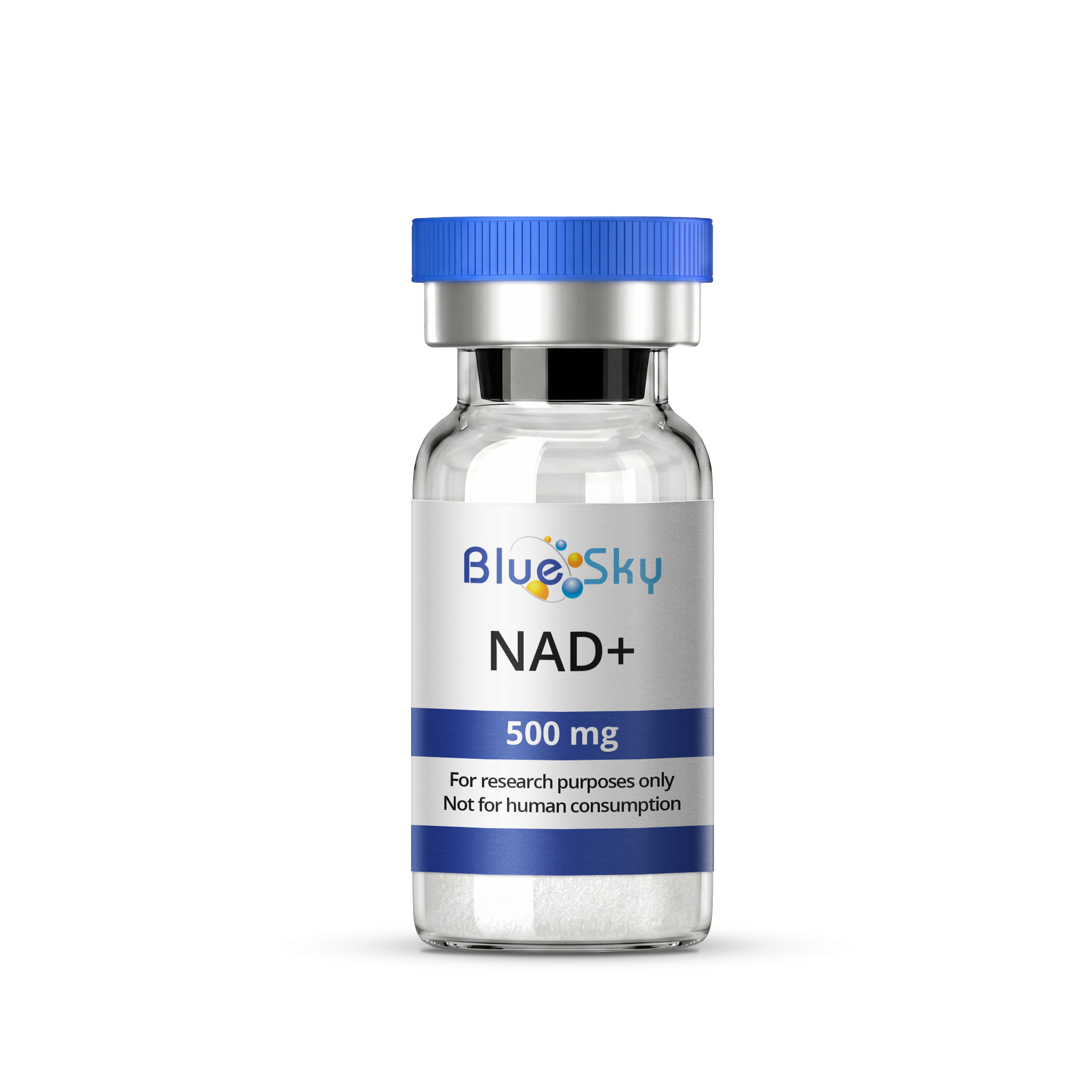
NAD+ 500mg

- Free Priority Shipping
- Orders over $75


Buy NAD+ 500mg :
| Unit Size | 500mg/vial |
| Unit Quantity | 1 vial |
| Purity (Mass Spectrometry and UV) | 97.70% |
| Sequence | N/A |
| Molecular Formula | C21H27N7O14P2 |
| Appearance | Lyophilized White Powder |
| Source | Chemical Synthesis |
| Storage | Lyophilized NAD+ is stable at room Temperature for 90 days, however it is best to store in a freezer below - 8c for any extended period of time. |
| Terms | The products we offer are intended for laboratory research use only. Please familiarize yourself with our terms of service prior to ordering. |
NAD+ 500mg
View Research Overview & References
NAD+ (Nicotinamide Adenine Dinucleotide) is a coenzyme present in all living cells and is studied in vitro for its role in cellular energy production and metabolism. NAD+ participates in redox reactions, serving as an electron transporter in the mitochondrial electron transport chain (ETC), which generates ATP.
Cellular NAD+ Flux and Consumption Research
In vitro studies using cultured human cell lines found that NAD+ was synthesized from nicotinamide and consumed largely by PARP and sirtuin enzymes, with isotope-tracer methods allowing researchers to quantify these synthesis and consumption rates directly within the cell-based system.1
Cellular Uptake of NAD+ Precursors
Research has examined the distinct cellular uptake mechanisms and enzymatic conversion pathways by which NAD+ precursor molecules, including nicotinamide mononucleotide (NMN) and nicotinamide riboside (NR), are transported across the cell membrane and converted into functional NAD+.2
DNA Repair Signaling Research
NAD+ is studied for its role in DNA repair signaling, functioning as a substrate for enzymes including PARPs (Poly ADP-ribose polymerases) and sirtuins. Sirtuins, a class of NAD+-dependent enzymes, are studied for their role in chromatin regulation and gene expression in cell-based models.
Molecular Structure and Redox Chemistry
NAD+ is a dinucleotide composed of an adenine-containing nucleotide joined to a nicotinamide-containing nucleotide through a pyrophosphate linkage.
The redox-active center of the molecule is the nicotinamide ring, which accepts a hydride ion to form NADH during oxidation reactions, a reversible reaction that researchers use as the basis for many enzymatic assays and spectrophotometric measurements in laboratory settings.
This hydride-transfer chemistry is what allows NAD+ to function as an electron carrier across the many metabolic pathways it participates in.
Analytical Purity Verification
Because NAD+ and its reduced form NADH have distinct UV absorbance profiles, spectrophotometric methods are commonly used alongside HPLC to verify purity and confirm that a sample has not undergone significant reduction or degradation during storage.
Researchers reviewing a certificate of analysis for NAD+ are encouraged to look for confirmation of the oxidized state specifically, since a sample that has partially converted to NADH will behave differently in redox-dependent assays despite reporting similar overall purity by mass.
Storage and Handling in the Laboratory Setting
NAD+ is hygroscopic and its glycosidic bonds are susceptible to hydrolysis, particularly under acidic conditions or with prolonged exposure to moisture, making airtight storage in lyophilized form under sub-zero freezer conditions the standard laboratory practice.
Protecting the powder from light and extended room-temperature exposure is also important, since both can accelerate degradation and shift the NAD+/NADH ratio in ways that could confound redox-sensitive experimental readouts.
Comparative Research Context Among NAD+ Precursors
NAD+ is frequently studied alongside its metabolic precursors, including nicotinamide mononucleotide (NMN) and nicotinamide riboside (NR).2
Researchers comparing NAD+ directly against these precursor molecules in laboratory models have focused on differences in membrane permeability and the enzymatic steps required for each to be converted into functional NAD+ within the cell, a distinction relevant to experimental design when choosing which form of the molecule to use in a given cell-based or biochemical assay.
Important Notice
This product is intended for laboratory research use (in vitro) only and is not intended for use in humans. These findings do not establish safety, efficacy, or suitability for any human application, and this product has not been evaluated by the FDA or any regulatory agency.
Product Information
This NAD+ 500mg product is supplied as a white, lyophilized powder specifically for in vitro laboratory research.
References
1. Liu L, Su X, Quinn WJ 3rd, et al. Quantitative analysis of NAD synthesis-breakdown fluxes. Cell Metab. 2018 May 1;27(5):1067-1080.e5.
2. Yoshino J, Baur JA, Imai SI. NAD+ intermediates: the biology and therapeutic potential of NMN and NR. Cell Metab. 2018;27(3):513-28.
 Buy Bulk BPC 157 5MG$77.95


 Login
Login