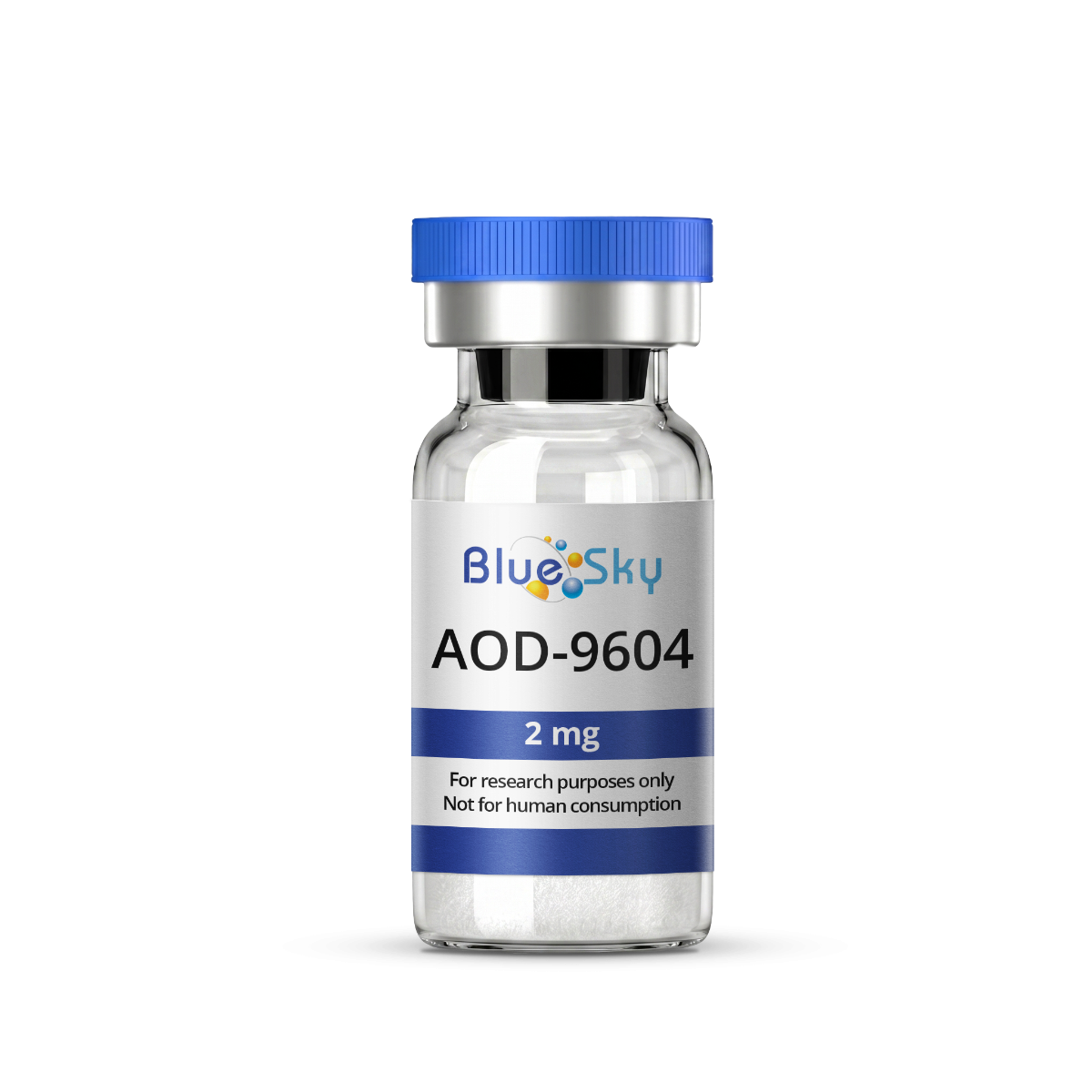
AOD-9604 2mg

- Free Priority Shipping
- Orders over $75



Buy AOD-9604 2mg :
| Unit Size | 2mg/vial |
| Unit Quantity | 1 vial |
| Purity (Mass Spectrometry and UV) | 99.95% |
| Sequence | H-Tyr-Leu-Arg-Ile-Val-Gln-Cys(1)-Arg-Ser-Val-Glu-Gly-Ser-Cys(1)-Gly-Phe-OH |
| Molecular Formula | C78H123N23O23S2 |
| Appearance | Lyophilized White Powder |
| Source | Chemical Synthesis |
| Storage |
Lyophilized AOD-9604 is stable at room temperature for 90 days, however it is best to store in a freezer below -8°C for any extended period of time. |
| Terms |
The products we offer are intended for laboratory research use only. Please familiarize yourself with our terms of service prior to ordering. |
AOD-9604 2mg
View Research Overview & References
AOD9604 is a synthetic peptide fragment derived from the C-terminal region of human growth hormone (HGH), studied in laboratory research as a structurally isolated fragment with properties distinct from the intact hormone. Research referenced here is limited to in vitro (cell-based) laboratory studies. This product is studied in vitro and is not intended for human use or consumption.
Why This Fragment Is Studied Separately from Full-Length hGH
AOD9604 corresponds to the C-terminal 15-amino-acid region of human growth hormone, a segment structurally separated from the portion of hGH responsible for its growth-promoting, IGF-1-driving signaling. Isolating this fragment allows researchers to study its cell-level properties independent of full-length hGH's broader hormonal activity.
This structural distinction is the basis for using AOD9604 as a research tool: because it lacks most of the hGH sequence, it is of interest for studying a small, defined peptide fragment's behavior in cell-based systems without the complexity of the intact hormone.
Cell-Based Toxicity and Genotoxicity Screening
A laboratory study assessed AOD9604 using standard in vitro screening methods for cellular safety signals:
- Cytotoxicity testing across multiple cultured cell types, which reported no cytotoxic effects in the cell lines tested
- A bacterial reverse mutation (Ames) test, a standard cell-based method for screening genotoxic potential
- A chromosomal aberration assay in cultured cells, examining whether the compound induces structural changes to chromosomes within a cell culture system
These are preliminary in vitro findings and do not establish safety for human use.1
Analytical Verification of Amino Acid Composition
AOD9604's sequence contains two tyrosine residues and one phenylalanine residue, aromatic amino acids that provide a distinct UV absorbance signature researchers use alongside mass spectrometry to confirm peptide identity and quantify concentration in solution.
Because the peptide also contains an internal disulfide bond, analytical verification typically distinguishes between the intact, disulfide-bonded form and any reduced (open-chain) form present in a sample, since the two forms differ measurably in mass and in their behavior under non-reducing versus reducing chromatography conditions.
Storage and Handling in the Laboratory Setting
Because AOD9604 contains an internal disulfide bond between its two cysteine residues, laboratories generally avoid reducing agents and excessive mechanical agitation when handling the compound, both of which can disrupt this bond and alter the peptide's folded structure.
Standard practice involves storing the lyophilized powder under sub-zero freezer conditions, which helps preserve structural integrity across the assay types referenced in this research summary.
Important Note
These findings are based exclusively on in vitro laboratory research. This product is not intended for human use or consumption, and has not been evaluated for safety or efficacy in humans outside of controlled in vitro laboratory research.
Summary
AOD9604 continues to be studied in cell-based laboratory models for its cytotoxicity and genotoxicity profile in cultured cells, and for its structural and analytical properties as a synthetic C-terminal hGH fragment. Its use remains strictly limited to in vitro laboratory research applications.
References
1. Moré MI, Kenley D. Safety and metabolism of AOD9604, a novel nutraceutical ingredient for improved metabolic health. J Endocrinol Metab. 2014;4(3):64-77.


 Login
Login