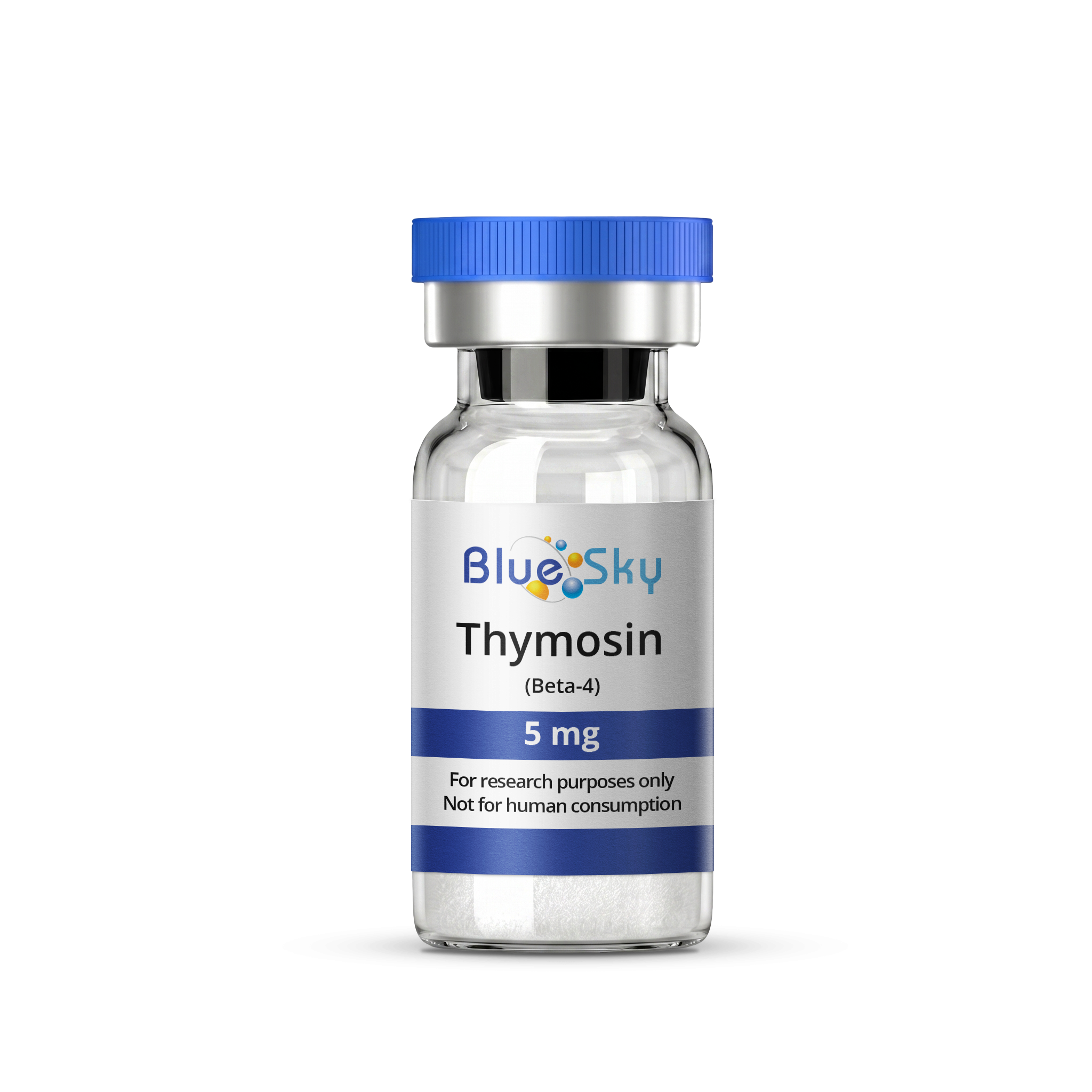
Thymosin Beta 4 (TB500) 5mg

- Free Priority Shipping
- Orders over $75


Buy Thymosin Beta 4 (TB500) 5MG :
| Unit Size | 5 mg/ vial |
| Unit Quantity | 1 vial |
| Purity (Mass Spectrometry and UV) | 99.87% |
| Sequence | Ac-Ser-Asp-Lys-Pro-Asp-Met-Ala-Glu-Ile-Glu-Lys-Phe-Asp-Lys-Ser- Lys-Leu-Lys-Lys-Thr-Glu-Thr-Gln-Glu-Lys-Asn-Pro-Leu-Pro-Ser-Lys- Glu-Thr-Ile-Glu-Gln-Glu-Lys- Gln-Ala-Gly-Glu-Ser-OH |
| Molecular Formula | C212H350N56O78S |
| Appearance | Lyophilized White Powder |
| Source | Chemical Synthesis |
| Storage | Lyophilized TB500 is stable at room Temperature for 90 days, however it is best to store in a freezer below - 8c for any extended period of time. |
| Terms | The products we offer are intended for laboratory research use only. Please familiarize yourself with our terms of service prior to ordering. |
Thymosin Beta 4 (TB500) 5mg
View Research Overview & References
Thymosin Beta 4 is a 43-amino-acid protein and the most abundant member of the beta-thymosin family of low molecular weight acidic peptides, found in nearly all cell types.
It functions as the principal G-actin sequestering peptide in the cytoplasm, forming a 1:1 complex with actin monomers that inhibits their polymerization into filaments.1
Living-Cell Actin Regulation Findings
In vitro research microinjecting synthetic Thymosin Beta 4 into cultured epithelial cells and fibroblasts found a dose-dependent depolymerization of actin filaments and diminished stress fibers, confirming the peptide's actin-sequestering activity within an intact cellular environment rather than in isolated protein solution alone.2
Vial Sizing for Larger-Scale Experimental Designs
A 5 mg vial provides a larger total peptide mass per container than smaller unit sizes, making it a practical choice for laboratories running serial comparisons or multiple parallel in vitro assays that require a larger total quantity of starting material.
Researchers running higher-throughput experimental designs often select larger unit sizes specifically to avoid needing multiple separate production batches within a single study.
Structural Basis of Actin Sequestration
Thymosin Beta 4's function as an actin monomer buffer is linked to its low isoelectric point and high proportion of acidic residues, properties thought to mediate electrostatic contact with the actin monomer surface.
Researchers comparing beta-thymosin family members for use in cytoskeletal assay systems have pointed to this acidic charge profile as a structural feature distinguishing beta-thymosins from other actin-binding proteins that regulate filament assembly through different mechanisms.
Analytical Identity Confirmation for Larger Peptide Batches
Because Thymosin Beta 4 is a comparatively large, 43-residue peptide, analytical confirmation of identity across an entire production batch is a more involved process than for shorter research peptides.
Laboratories typically rely on mass spectrometry to confirm the intact peptide mass and HPLC to assess chromatographic purity, with particular attention paid to detecting partial-length synthesis products that can co-elute closely with the full-length peptide.
TB500 in the Context of Cytoskeletal Dynamics Research
Thymosin Beta 4 was first isolated from thymic tissue in the 1960s and has since become one of the most extensively studied members of the beta-thymosin family, which also includes thymosin beta-10 and thymosin beta-15.
Laboratory research comparing these isoforms has focused on differences in tissue expression patterns and relative actin-binding affinity, using Thymosin Beta 4 as the reference compound given the depth of existing structural and functional data.
Important Notice
TB500 is intended exclusively for in vitro laboratory research use only. It is not approved for human use, diagnostic use, or therapeutic use, and has not been evaluated for safety or efficacy in humans.
Product Information
TB500 is available as a white lyophilized powder with a concentration of 5 mg per vial, strictly for in vitro laboratory use.
References
1. Huff T, Müller CS, Otto AM, Netzker R, Hannappel E. Beta-Thymosins, small acidic peptides with multiple functions. Int J Biochem Cell Biol. 2001 Mar;33(3):205-20.
2. Sanders MC, Goldstein AL, Wang YL. Thymosin beta 4 (Fx peptide) is a potent regulator of actin polymerization in living cells. Proc Natl Acad Sci U S A. 1992 May 15;89(10):4678-4682.


 Login
Login