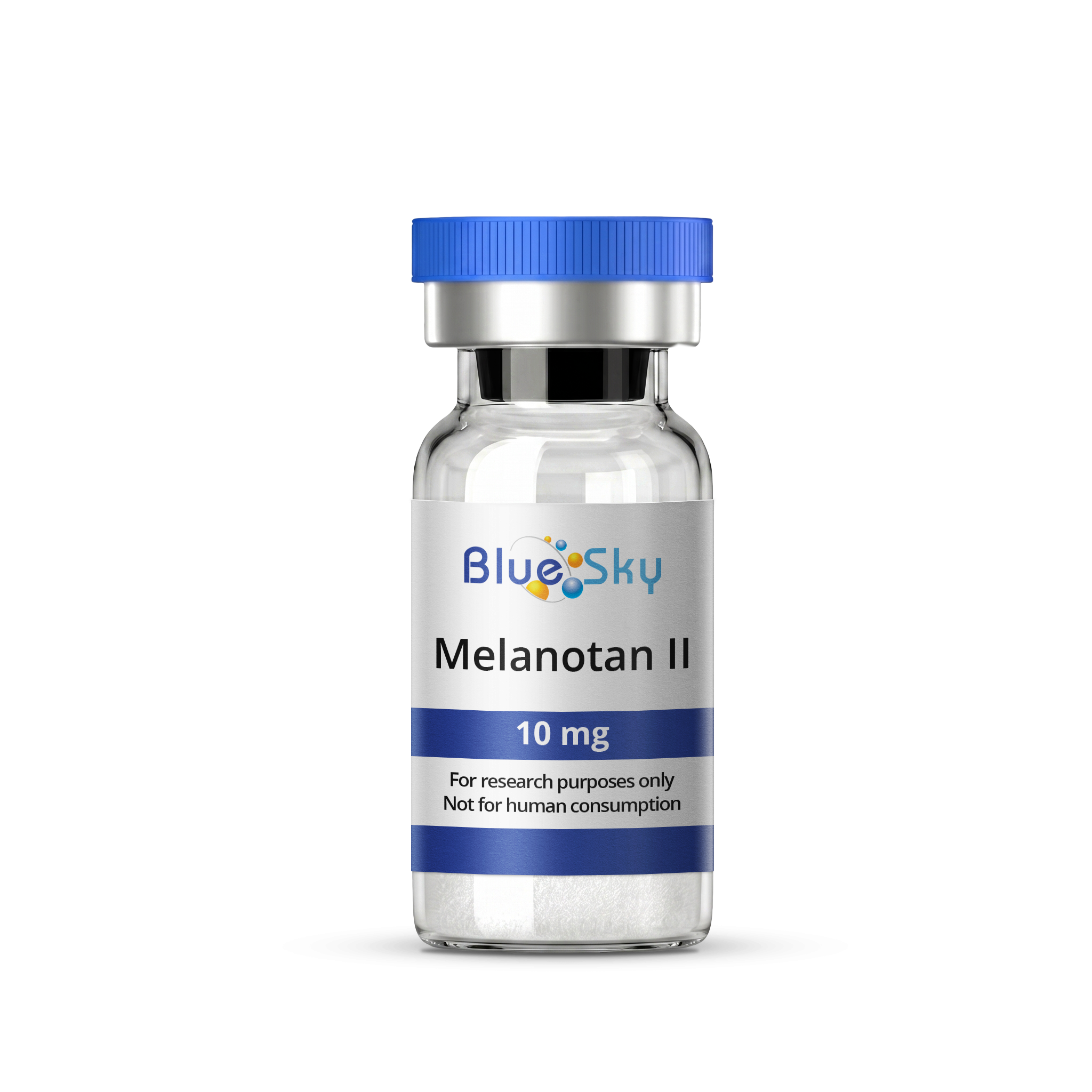
MELANOTAN II 10mg

- Free Priority Shipping
- Orders over $75



Buy Melanotan II 10mg :
| Unit Size | 10 mg/vial |
| Unit Quantity | 1 vial |
| Purity (Mass Spectrometry and UV) | 99.94% |
| Sequence | Ac-Nle-Asp-His-d-Phe-Arg-Trp-Lys-NH2 |
| Molecular Formula | C50H69N15O9 |
| Appearance | Lyophilized White Powder |
| Source | Chemical Synthesis |
| Storage | Lyophilized Melanotan II is stable at room Temperature for 90 days, however it is best to store in a freezer below - 8c for any extended period of time.. |
| Terms | The products we offer are intended for laboratory research use only. Please familiarize yourself with our terms of service prior to ordering. |
MELANOTAN II 10mg
View Research Overview & References
Melanotan II is a synthetic analog of alpha-melanocyte-stimulating hormone (α-MSH), studied in vitro as an agonist at melanocortin receptors, including MC1R, the receptor primarily responsible for melanogenesis in melanocytes.
Melanogenesis Signaling Research
In vitro studies using B16F10 mouse melanoma cells, an established melanocyte-lineage cell line, found that α-MSH stimulation increased melanin content and tyrosinase enzyme activity, and elevated expression of AhR, CTNNB1, and MITF, genes involved in the melanogenesis pathway.
Knockdown of the aryl hydrocarbon receptor (AhR) in these cells altered this response, indicating a regulatory role for AhR in α-MSH-induced melanogenesis signaling within this cell-based system.1
Peptide Design and Structural Modifications
Melanotan II is distinguished from native α-MSH by several deliberate structural modifications studied in peptide chemistry research.
A norleucine (Nle) substitution at the position corresponding to methionine in the native hormone removes a residue prone to oxidative degradation, a common concern when working with methionine-containing peptides in laboratory settings.
The peptide is also cyclized through a lactam bridge linking the Asp and Lys side chains, a modification studied for its effect on constraining the peptide's conformation and increasing resistance to enzymatic breakdown relative to linear melanocortin fragments.
The inclusion of a D-phenylalanine residue in place of the corresponding L-amino acid is another feature researchers examine when comparing metabolic stability across melanocortin receptor agonists used in in vitro assay systems.
Analytical Purity Verification
Purity testing for Melanotan II research material typically combines high-performance liquid chromatography (HPLC) with mass spectrometry to confirm both the cyclized structure and the absence of linear (non-cyclized) synthesis byproducts, which can co-occur during lactam bridge formation.
Because the cyclization step introduces additional complexity relative to linear peptide synthesis, researchers often place particular emphasis on confirming ring closure via mass confirmation rather than relying on HPLC retention time alone.
Storage and Handling in the Laboratory Setting
Melanotan II is best preserved in its freeze-dried state under sub-zero freezer storage when not in active use, since the lactam-cyclized structure, while more stable than a linear analog, remains susceptible to degradation once exposed to moisture or ambient conditions.
Laboratories typically limit the powder's exposure to light and room temperature, both of which are known to accelerate peptide degradation.
Comparative Research Context Among Melanocortin Agonists
Melanotan II is frequently referenced in laboratory literature alongside other melanocortin receptor agonists, including NDP-α-MSH, as researchers compare receptor selectivity and binding kinetics across this peptide class.
Its non-selective activity across multiple melanocortin receptor subtypes distinguishes it from more selective agonists developed later through targeted structure-activity relationship studies, a distinction commonly cited when researchers select a melanocortin tool compound for a specific receptor-subtype assay design.
Important Notice
Melanotan II is intended exclusively for laboratory research use (in vitro) and is not approved for human use, diagnostics, or therapeutic applications. Any application outside of controlled research settings is prohibited, and these findings do not establish safety, efficacy, or suitability for any human application.
References
1. Ghaffarian-Bahraman A, Jamshidzadeh A, Keshavarzi M, Arabnezhad MR, Mohammadi H, Mohammadi-Bardbori A. α-Melanocyte-Stimulating Hormone Triggers Melanogenesis Via Activation of the Aryl Hydrocarbon Receptor Pathway in B16F10 Mouse Melanoma Cells. Int J Toxicol. 2021;40(2):153-160.


 Login
Login