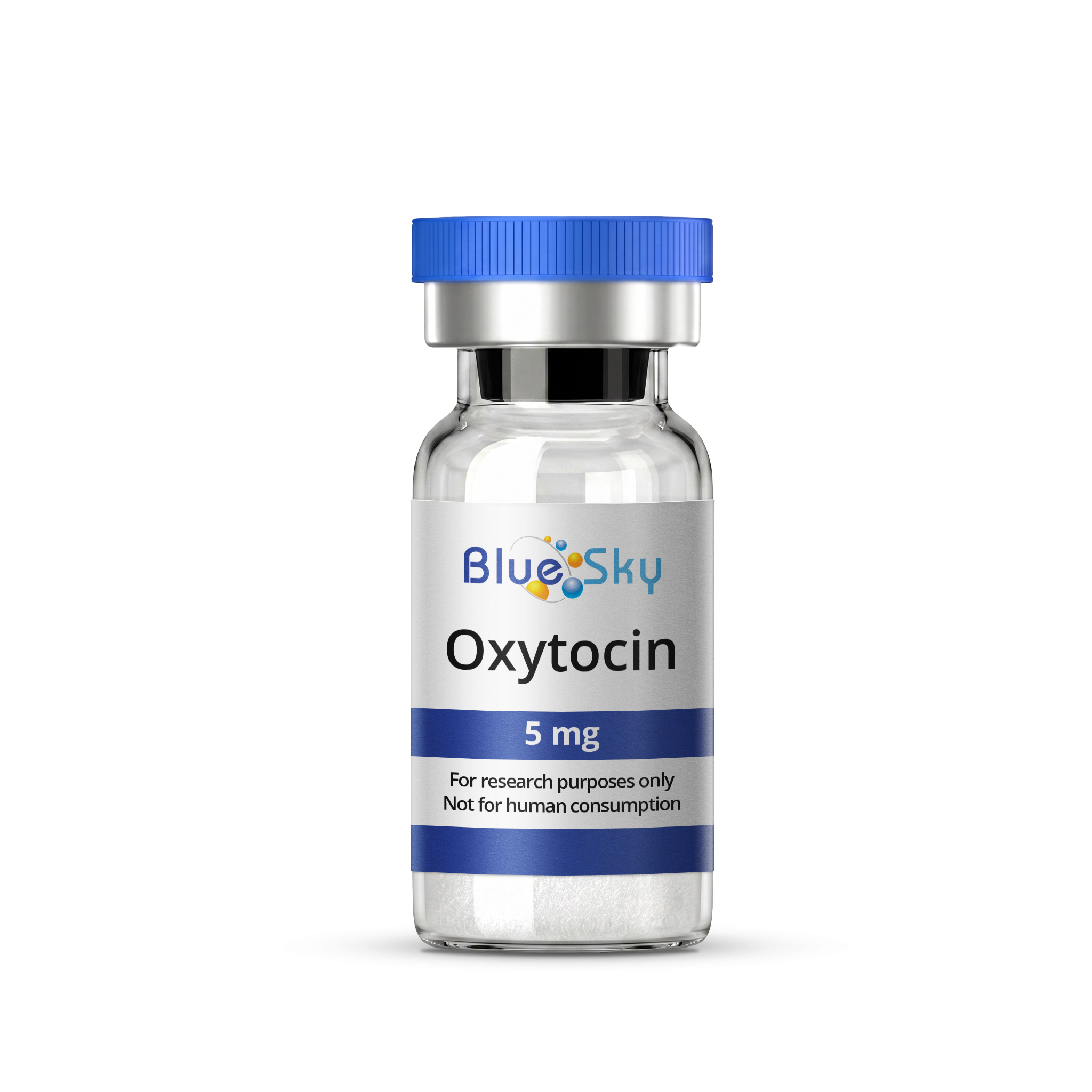
Oxytocin 5mg

- Free Priority Shipping
- Orders over $75



Buy Oxytocin 5mg:
| Unit Size | 5mg/vial |
| Unit Quantity | 1 vial |
| Purity (Mass Spectrometry and UV) | 98.52% |
| Sequence | Cys(1)-Tyr-Ile-Gln-Asn-Cys(1)-Pro-Leu-Gly-NH2 |
| Molecular Formula | C43H66N12O12S2 |
| Appearance | Lyophilized White Powder |
| Source | Chemical Synthesis |
| Storage | Lyophilized Oxytocin is stable at room Temperature for 90 days, however it is best to store in a freezer below - 8c for any extended period of time. |
| Terms | The products we offer are intended for laboratory research use only. Please familiarize yourself with our terms of service prior to ordering. |
Oxytocin 5mg
View Research Overview & References
Oxytocin is a neuropeptide hormone studied in laboratory research for its receptor signaling properties and its effects in cultured cell models. This product is studied in vitro and is not intended for human use or consumption.
Oxytocin Receptor Signaling and Crosstalk Research
In vitro studies using HEK293 cells, an established human cell line, stably expressing the TrkB receptor found that transfecting these cells with the oxytocin receptor increased TrkB receptor tyrosine phosphorylation upon oxytocin exposure.
This finding supports a mechanism of receptor crosstalk between the oxytocin receptor and the TrkB receptor system within this cell-based system, distinguishable from the related vasopressin receptor.1
Cancer Cell Line Proliferation Research
In vitro studies using human breast cancer cell lines, including MCF7, MDA-MB231, and T47D, found that oxytocin treatment inhibited cell proliferation, with these cell lines confirmed to express oxytocin receptor mRNA.
In MCF7 and T47D cells, oxytocin also enhanced the growth-inhibitory effect of tamoxifen, a commonly used anti-estrogen research compound, on cell proliferation within this cell-based system.2
Peptide Structure: The Disulfide-Cyclized Tocin Ring
Oxytocin's nine-residue sequence forms a 20-membered ring through a disulfide bond between its two cysteine residues at positions 1 and 6, with a short linear tail (Pro-Leu-Gly-NH2) extending from the ring.
Researchers studying structure-activity relationships in this peptide family have noted that oxytocin differs from the closely related neuropeptide vasopressin at only two positions, isoleucine versus phenylalanine at position 3 and leucine versus arginine at position 8, and that these two substitutions account for the differing receptor selectivity between the two hormones despite their otherwise near-identical scaffolds.
Analytical Purity Verification
Purity verification for oxytocin typically combines HPLC and mass spectrometry to confirm both the correct 9-residue sequence and the intact disulfide bond forming the tocin ring, since reduction of this bond is understood to abolish the peptide's characteristic folded structure.
Researchers reviewing a certificate of analysis are encouraged to confirm that analytical testing addresses disulfide bond integrity specifically, rather than sequence mass alone, given how central this structural feature is to the molecule's studied receptor-binding behavior.
Storage and Handling in the Laboratory Setting
Oxytocin is understood in the research literature to be a relatively labile peptide, with its disulfide bond and C-terminal amide both susceptible to degradation under suboptimal storage conditions.
Standard laboratory practice involves storing the lyophilized powder under sub-zero freezer conditions, away from light and moisture, which helps preserve the intact ring structure relevant to receptor-binding assays.
Comparative Research Context: Oxytocin and Vasopressin
Oxytocin is frequently studied alongside vasopressin in comparative receptor pharmacology research, given their close structural homology and shared evolutionary origin from a common ancestral nonapeptide.
Researchers investigating receptor selectivity have used the two position-3 and position-8 substitutions between the hormones as a natural structure-function model for understanding how small sequence changes in a conserved peptide scaffold can redirect receptor binding preference in cell-based assay systems.
Important Compliance Notice
Oxytocin is intended for laboratory research use only (in vitro). It is not suitable for human consumption, diagnostic use, or therapeutic applications, and has not been evaluated for safety or efficacy in humans. Researchers are required to follow appropriate laboratory safety protocols when working with this product.
References
1. Mitre M, Saadipour K, Williams K, Khatri L, Froemke RC, Chao MV. Transactivation of TrkB receptors by oxytocin and its G protein-coupled receptor. Front Mol Neurosci. 2022;15:891537.
2. Cassoni P, Sapino A, Negro F, Bussolati G. Oxytocin inhibits proliferation of human breast cancer cell lines. Virchows Arch. 1994;425(5):467-472.


 Login
Login