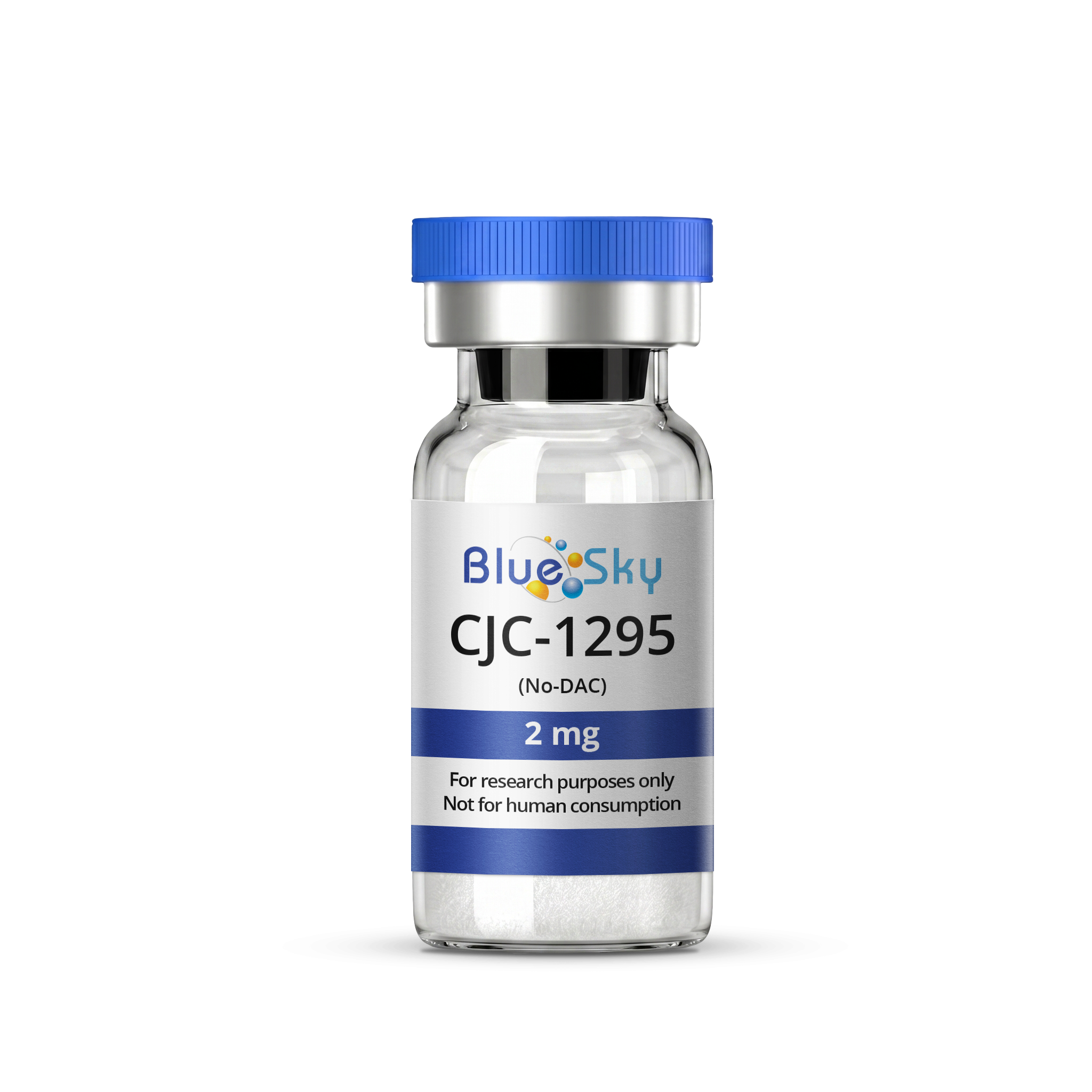
CJC-1295 NO-DAC 2mg (MOD GRF 1-29)

- Free Priority Shipping
- Orders over $75



Buy 1 Get 1 Free CJC-1295 NO-DAC (MOD GRF 1-29) 2mg :
| Unit Size | 2 mg/vial |
| Unit Quantity | 1 vial |
| Purity (Mass Spectrometry and UV) | 99.18% |
| Sequence | H-Tyr-D-Ala-Asp-Ala-Ile-Phe-Thr-Gln-Ser-Tyr-Arg-Lys-Val-Leu-Ala- Gln-Leu-Ser-Ala-Arg-Lys-Leu-Leu-Gln-Asp-Ile-Leu-Ser-Arg-NH2 |
| Molecular Formula | C152H252N44O42 |
| Appearance | Lyophilized White Powder |
| Source | Chemical Synthesis |
| Storage | Lyophilized CJC-1295 NO-DAC is stable at room Temperature for 90 days, however it is best to store in a freezer below - 8c for any extended period of time. |
| Terms | The products we offer are intended for laboratory research use only. Please familiarize yourself with our terms of service prior to ordering. |
CJC-1295 NO-DAC 2mg (MOD GRF 1-29)
View Research Overview & References
CJC-1295 NO-DAC is a synthetic peptide studied in vitro, featuring the first 29 amino acids of growth hormone-releasing hormone (GHRH), also called modified growth releasing factor 1-29 (MOD GRF 1-29). This peptide has a molecular weight of approximately 3.4 kDa.
GHRH Receptor Binding Research
Structural and computational modeling has characterized the GHRH receptor's dynamic conformational behavior, identifying the molecular determinants that govern ligand binding at this receptor and offering a mechanistic basis for how CJC-1295 NO-DAC's retained GHRH-derived sequence is positioned to engage it.1
Peptide Design: Four Stabilizing Substitutions to Native GRF
CJC-1295 NO-DAC carries four amino acid substitutions relative to the native 29-residue GRF sequence, each addressing a specific degradation pathway studied in peptide stability research.
The D-alanine substitution at position 2 is understood to block cleavage by dipeptidyl peptidase-IV, an enzyme that rapidly truncates native GRF at this position in biological systems. The glutamine substitution at position 8 is designed to prevent spontaneous deamidation of the native asparagine residue, a common degradation route for asparagine-containing peptides over time.
The alanine substitution at position 15 and the leucine substitution at position 27, which replaces a native methionine, are studied for reducing susceptibility to oxidation, since methionine residues are particularly prone to oxidative modification during storage and handling. Together, these four changes are the basis for the peptide's improved in vitro stability relative to unmodified GRF(1-29).
Analytical Purity Verification
As a 29-residue peptide, CJC-1295 NO-DAC presents more opportunities for synthesis-related impurities—such as deletion sequences or incomplete couplings—than shorter research peptides, making combined HPLC and mass spectrometry verification particularly important.
Researchers reviewing a certificate of analysis for this compound are encouraged to confirm both the overall purity percentage and the mass-spectrometric match to the full 29-residue sequence, since partial-length synthesis byproducts can be similar in mass to legitimate degradation products.
Storage and Handling in the Laboratory Setting
Despite its stabilizing substitutions, CJC-1295 NO-DAC is still a moderately large peptide susceptible to degradation under poor storage conditions.
Standard laboratory practice involves storing the lyophilized powder under sub-zero freezer conditions, since the intact 29-residue sequence is more vulnerable to hydrolysis and aggregation once the material is no longer in its stable, freeze-dried state.
Comparative Research Context Among GHRH Analogs
CJC-1295 NO-DAC is frequently discussed alongside other GHRH(1-29)-derived research peptides, including unmodified Sermorelin, which shares the same core sequence but lacks the four stabilizing substitutions described above and is correspondingly studied as having a much shorter half-life in vitro.
Researchers comparing these GHRH analogs have used differences in stability and receptor-binding duration to inform experimental design when a study calls for either transient or more sustained receptor occupancy in cell-based GHRH receptor assays.
Product Information
CJC-1295 NO-DAC is provided as a 2 mg lyophilized powder in a vial, intended strictly for in vitro laboratory research.
Important Notice
This product is intended for laboratory research use (in vitro) only. It is not suitable for human use outside controlled research settings, and has not been evaluated for safety or efficacy in humans.
References
1. Matsoukas MT, Spyroulias GA. Dynamic properties of the growth hormone-releasing hormone receptor (GHRHR) and molecular determinants of GHRH binding. Mol Biosyst. 2017 Jun 27;13(7):1313-1322.


 Login
Login