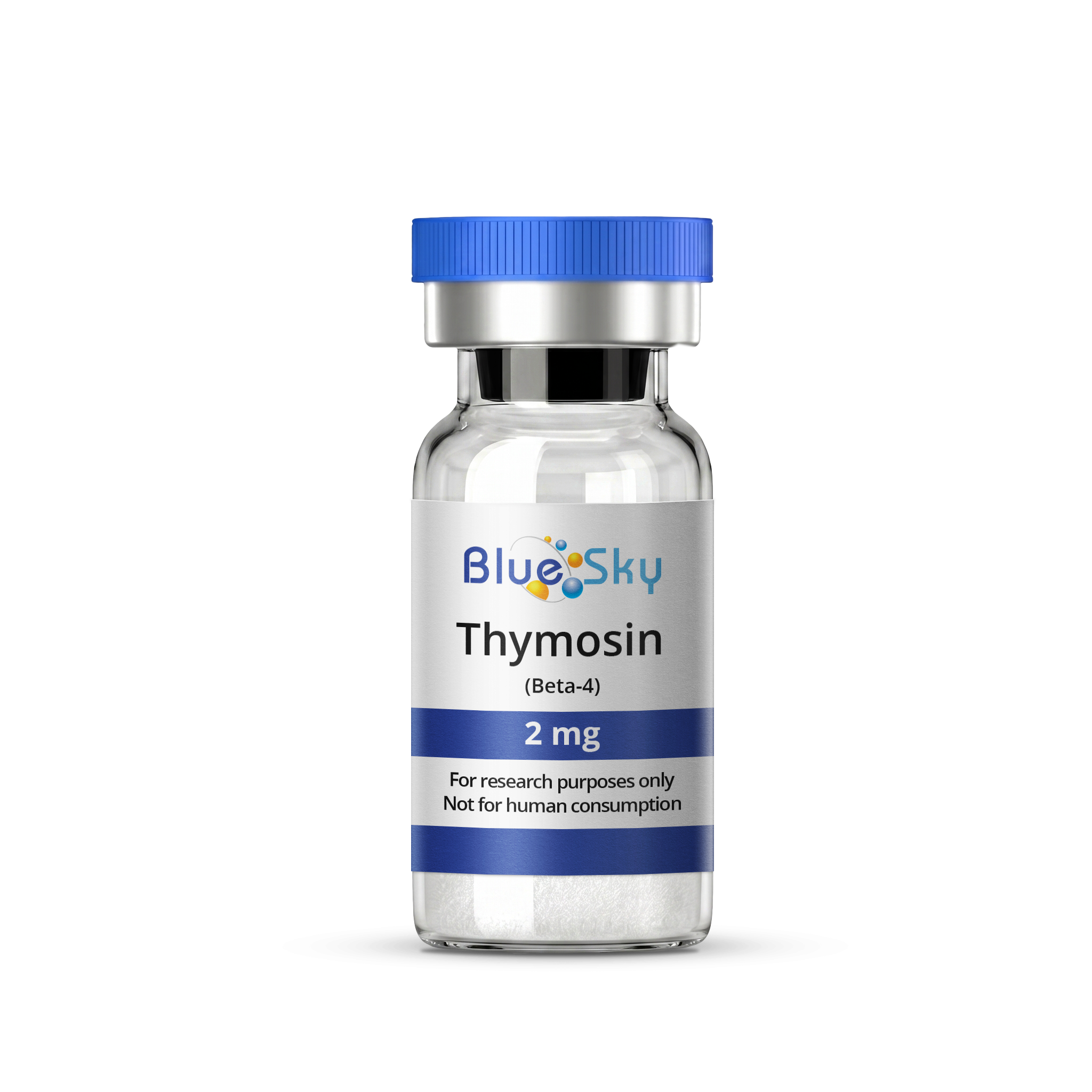
Thymosin Beta 4 (TB500) 2mg

- Free Priority Shipping
- Orders over $75


Buy Thymosin Beta 4 (TB500) 2MG Peptide:
| Unit Size | 2 mg/ vial |
| Unit Quantity | 1 vial |
| Purity (Mass Spectrometry and UV) | 99.87% |
| Sequence | Ac-Ser-Asp-Lys-Pro-Asp-Met-Ala-Glu-Ile-Glu-Lys-Phe-Asp-Lys-Ser- Lys-Leu-Lys-Lys-Thr-Glu-Thr-Gln-Glu-Lys-Asn-Pro-Leu-Pro-Ser-Lys- Glu-Thr-Ile-Glu-Gln-Glu-Lys- Gln-Ala-Gly-Glu-Ser-OH |
| Molecular Formula | C212H350N56O78S |
| Appearance | Lyophilized White Powder |
| Source | Chemical Synthesis |
| Storage | Lyophilized TB500 is stable at room Temperature for 90 days, however it is best to store in a freezer below - 8c for any extended period of time. |
| Terms | The products we offer are intended for laboratory research use only. Please familiarize yourself with our terms of service prior to ordering. |
Thymosin Beta 4 (TB500) 2mg
View Research Overview & References
Thymosin Beta 4 is a 43-amino-acid protein, encoded by the TMSB4X gene and part of the thymosin family of low molecular weight acidic peptides. Found in all cell types except red blood cells, this protein is studied in vitro for its role in cell motility and differentiation.
Actin-Binding Mechanism Research
Thymosin Beta 4 forms a 1:1 complex with monomeric actin (G-actin), acting as an actin buffer. This complex inhibits the polymerization of actin into filaments (F-actin), maintaining a pool of actin monomers relevant to laboratory research on cell migration and cell differentiation pathways.1
Cell-Based Actin Regulation Research
In vitro research using cultured living epithelial cells and fibroblasts found that microinjecting synthetic Thymosin Beta 4 into these cells produced a dose-dependent depolymerization of actin filaments and a reduction in stress fibers, building on earlier biochemical work showing the peptide binds actin in cell-free extracts and inhibits polymerization in vitro.2
Peptide Structure and Fragment Considerations
TB-500 is studied in laboratory settings as a synthetic peptide corresponding to a defined region of the full-length Thymosin Beta 4 sequence, centered on the conserved actin-binding motif that mediates the protein's interaction with G-actin monomers.
Because full-length Thymosin Beta 4 is a 43-residue protein, researchers working with synthetic fragments or full-sequence analogs often examine how closely a given research compound's structure preserves this actin-binding region, since even minor sequence deviations in this domain can alter binding behavior in cell-free and cell-based assay systems.
Analytical Purity Verification
Laboratory-grade Thymosin Beta 4 is typically verified using high-performance liquid chromatography (HPLC) paired with mass spectrometry, a combination that allows researchers to confirm sequence identity across all 43 residues and detect truncation or oxidation artifacts that can occur during synthesis of longer peptide chains.
Because this compound is substantially larger than many single-domain research peptides, purity verification is considered especially important, as incomplete synthesis products of similar mass can be more difficult to resolve analytically.
Storage and Handling in the Laboratory Setting
Given its larger molecular size relative to shorter research peptides, Thymosin Beta 4 is particularly sensitive to oxidation at its internal methionine residue, a consideration that informs laboratory storage protocol.
Lyophilized powder form is preferred for long-term storage under sub-zero freezer conditions to limit oxidative exposure.
Comparative Research Context Among Beta-Thymosins
Thymosin Beta 4 belongs to a small family of beta-thymosin peptides that share a common actin-sequestering function, including thymosin beta-10 and thymosin beta-15, which are also referenced in laboratory literature studying cytoskeletal regulation.
Researchers frequently cite Thymosin Beta 4 as the most abundant and best-characterized member of this family when designing comparative experiments examining isoform-specific differences in actin affinity or cell-type expression patterns.
Important Notice
TB500 is intended exclusively for in vitro laboratory research use only. It is not approved for human use, diagnostic use, or therapeutic use, and has not been evaluated for safety or efficacy in humans.
Product Information
TB500 is available as a white lyophilized powder with a concentration of 2 mg per vial, strictly for in vitro laboratory use.
References
1. Huff T, Müller CS, Otto AM, Netzker R, Hannappel E. Beta-Thymosins, small acidic peptides with multiple functions. Int J Biochem Cell Biol. 2001 Mar;33(3):205-20.
2. Sanders MC, Goldstein AL, Wang YL. Thymosin beta 4 (Fx peptide) is a potent regulator of actin polymerization in living cells. Proc Natl Acad Sci U S A. 1992 May 15;89(10):4678-4682.
 Buy Bulk BPC 157 5MG$77.95
 Buy Bulk Semaglutide 5mg$152.95
 Buy Bulk GHRP-6 5mg$45.95


 Login
Login