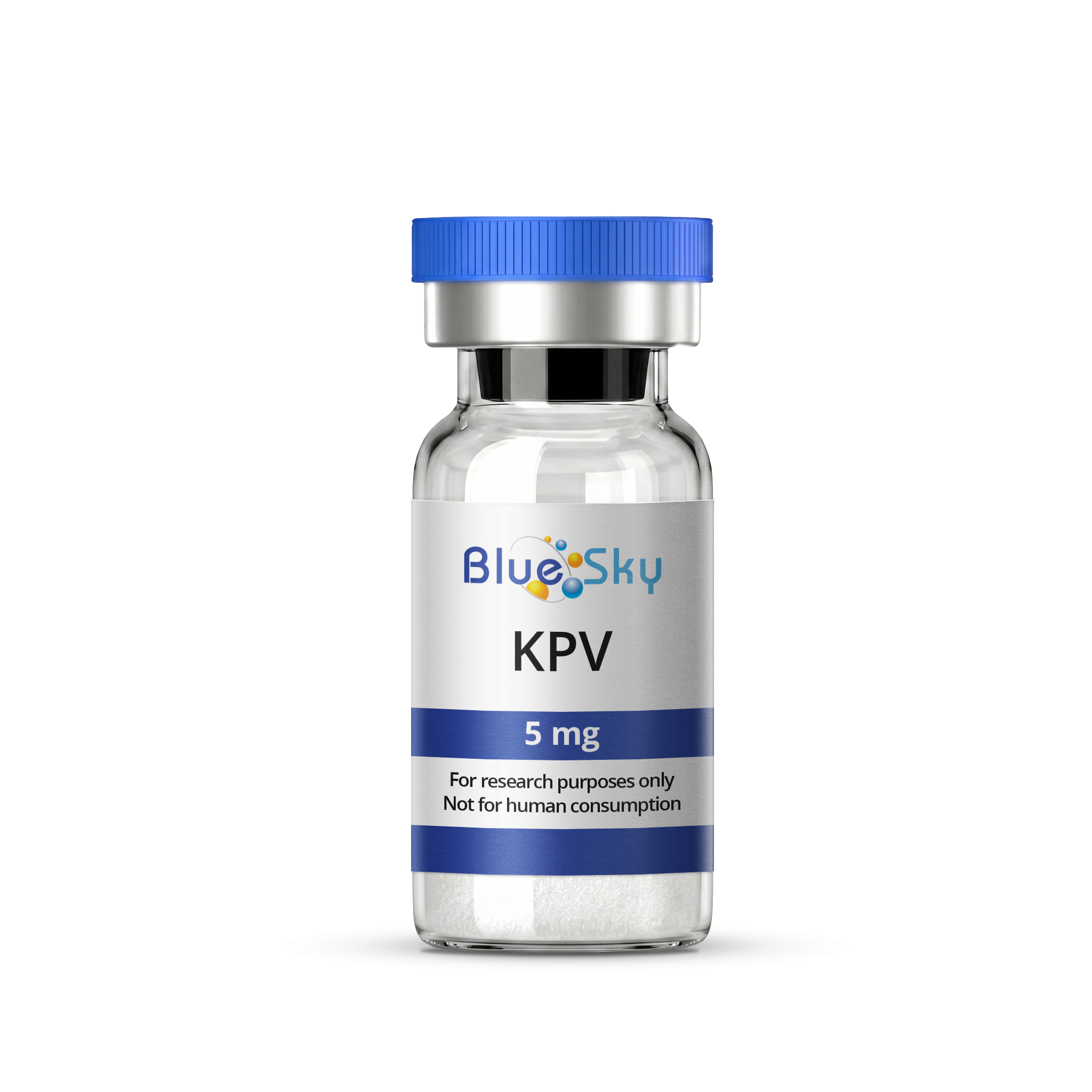
KPV 5mg

- Free Priority Shipping
- Orders over $75



Buy KPV 5mg :
| Unit Size | 5mg/vial |
| Unit Quantity | 1 vial |
| Purity (Mass Spectrometry and UV) | 99.73% |
| Sequence | Lys–Pro–Val |
| Molecular Formula | C16H30N4O4 |
| Appearance | Lyophilized White Powder |
| Source | Chemical Synthesis |
| Storage | Lyophilized KPV is stable at room Temperature for 90 days, however it is best to store in a freezer below - 8c for any extended period of time. |
| Terms | The products we offer are intended for laboratory research use only. Please familiarize yourself with our terms of service prior to ordering. |
KPV 5mg
View Research Overview & References
KPV Peptide is a tripeptide composed of lysine, proline, and valine (Lys–Pro–Val). It is a bioactive fragment derived from the C-terminal region of α-melanocyte-stimulating hormone (α-MSH), studied in vitro for its role in cellular inflammatory signaling pathways.
Signaling Research in Human Keratinocyte Cells
In vitro studies using human keratinocyte cells found that KPV, along with the related fragment MSH 11-13, engaged signaling pathways shared with adrenocorticotropic hormone within this cell-based system.1
Receptor-Independent Mechanism Considerations
Unlike larger melanocortin peptides, KPV has demonstrated activity in vitro that appears to be partially independent of classical melanocortin receptors. This characteristic makes KPV particularly useful for research focused on non-receptor-mediated signaling, peptide transport, and intracellular interactions.
As a simplified peptide fragment, KPV is frequently used in structure–function studies involving short bioactive peptides.
Peptide Structure and Proline-Constrained Conformation
As one of the shortest bioactive peptide fragments studied in melanocortin research, KPV's three-residue structure is defined largely by its central proline residue, which restricts the peptide's backbone flexibility more than a fully flexible tripeptide of standard amino acids would allow.
Researchers studying structure-function relationships in short bioactive peptides have pointed to this proline-imposed rigidity as a factor relevant to how KPV engages its binding targets despite lacking most of the structural features found in the full-length α-MSH molecule from which it is derived.
Analytical Considerations for a Highly Labile Tripeptide
Because KPV is an unprotected, free tripeptide with no cyclization or stabilizing modification, it is understood in the research literature to be more susceptible to rapid enzymatic breakdown by peptidases than longer or structurally modified research peptides.
This lability is a significant consideration in experimental design, since standard mass spectrometry and HPLC purity verification confirm the intact tripeptide at the time of analysis but do not guarantee stability throughout an extended in vitro incubation period.
Storage and Handling in the Laboratory Setting
Given its short sequence and susceptibility to peptidase activity, KPV is generally stored in lyophilized form under sub-zero freezer conditions to minimize degradation prior to use, since prolonged storage at room temperature is more likely to compromise peptide integrity than is the case for longer, more structurally stable research peptides.
Comparative Research Context Among Melanocortin-Derived Tripeptides
KPV is often studied alongside other short peptide fragments derived from or related to α-MSH, including a structurally related tripeptide that substitutes D-proline and a different C-terminal residue.
Researchers comparing these short fragments have focused on how differences in sequence and stereochemistry correspond to differences in receptor-independent activity and stability profiles observed across in vitro models.
Important Notice
This KPV peptide product is strictly for laboratory research use (in vitro) and is not approved for human use. Any application outside of controlled laboratory research is prohibited. These findings do not establish safety, efficacy, or suitability for clinical or diagnostic purposes.
Product Information
KPV is supplied for research purposes only. It should be handled by trained laboratory personnel and used in accordance with appropriate safety protocols.
References
1. Elliott RJ, Szabo M, Wagner MJ, Kemp EH, MacNeil S, Haycock JW. Alpha-melanocyte-stimulating hormone, MSH 11-13 KPV and adrenocorticotropic hormone signalling in human keratinocyte cells. J Invest Dermatol. 2004;122(4):1010–1019.


 Login
Login