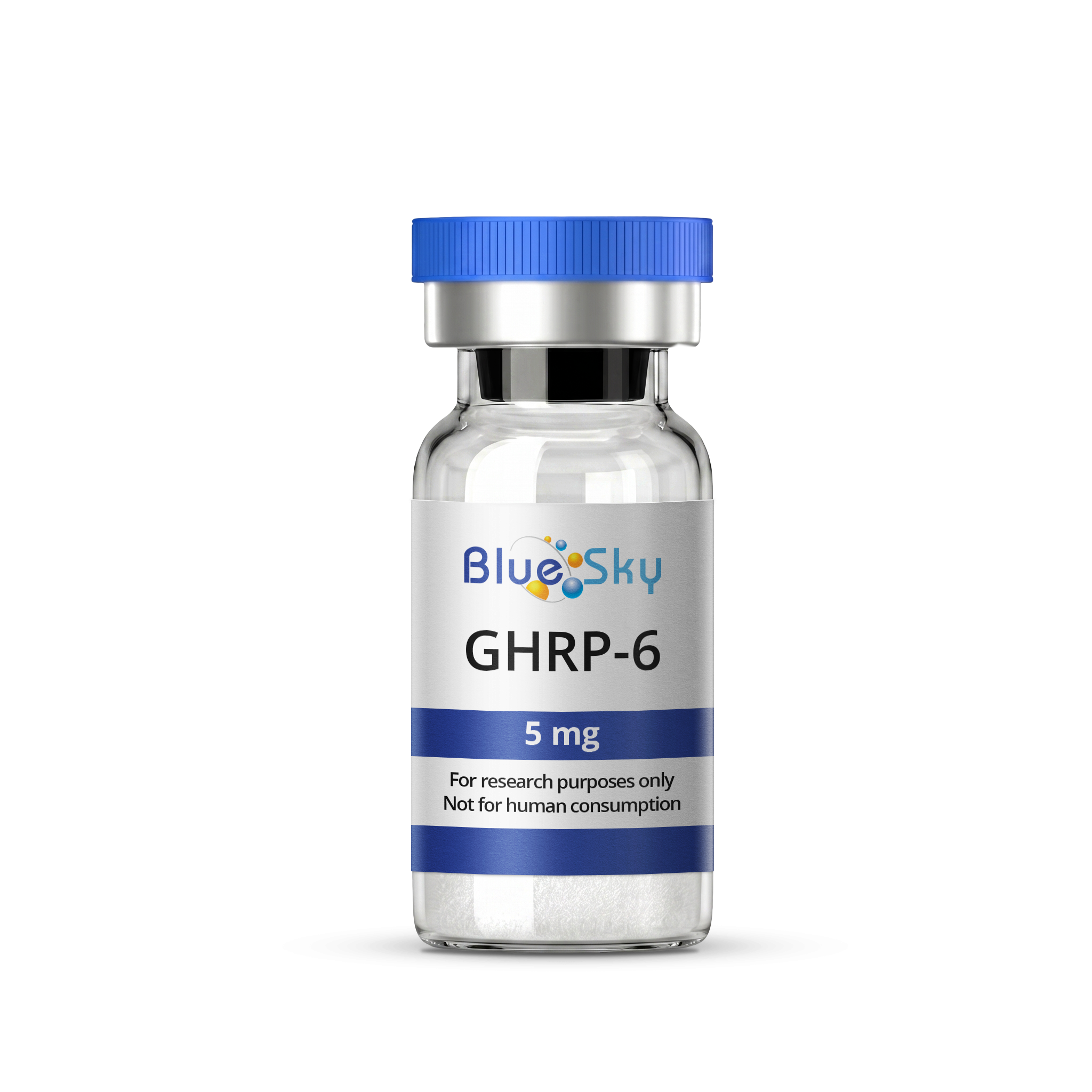
GHRP-6 5mg

- Free Priority Shipping
- Orders over $75



Buy 1 Get 1 Free GHRP-6 5mg:
| Unit Size | 5 mg/vial |
| Unit Quantity | 1 vial |
| Purity (Mass Spectrometry and UV) | 99.47% |
| Sequence | H-His-D-Trp-Ala-Trp-D-Phe-Lys-NH2 |
| Molecular Formula | C46H56N12O6 |
| Appearance | Lyophilized White Powder |
| Source | Chemical Synthesis |
| Storage | Lyophilized GHRP-6 is stable at room Temperature for 90 days, however it is best to store in a freezer below - 8c for any extended period of time. |
| Terms | The products we offer are intended for laboratory research use only. Please familiarize yourself with our terms of service prior to ordering. |
GHRP-6 5mg
View Research Overview
GHRP-6, or growth hormone-releasing peptide 6, is a synthetic hexapeptide studied in vitro for its interaction with the growth hormone secretagogue receptor (GHS-R), the same receptor activated by the endogenous hormone ghrelin.
GHRP-6 is composed of six amino acids, including two unnatural D-amino acids. Its amino acid sequence is as follows:
- L-Histidine
- D-Tryptophan
- L-Alanine
- L-Tryptophan
- D-Phenylalanine
- L-Lysine
Tryptophan Content and Analytical Detection
GHRP-6 is notable among GHRP-class secretagogues for containing two tryptophan-derived residues, one in the L-configuration and one in the D-configuration, giving it a higher aromatic indole content than related peptides such as GHRP-2 or ipamorelin.
This dual-tryptophan composition provides a strong UV chromophore that researchers rely on for spectroscopic detection during chromatographic purity work, but also makes the peptide comparatively more susceptible to photodegradation than secretagogues with a single or no tryptophan residue.
Historical Position Among GHRP-Class Secretagogues
GHRP-6 was among the earliest members of the growth hormone-releasing peptide class to be characterized, and later secretagogues in this family, including GHRP-2 and hexarelin, were developed as structural modifications of this earlier scaffold.
Researchers studying structure-activity relationships across the GHRP class often reference GHRP-6's sequence as the starting template against which later substitutions, such as the naphthylalanine or methylated tryptophan residues found in its successors, are compared.
Peptide Structure and D-Amino Acid Substitutions
GHRP-6's two D-amino acid residues, D-tryptophan and D-phenylalanine, occupy positions in the sequence that would otherwise be highly susceptible to cleavage by exopeptidases in biological research systems.
Researchers studying secretagogue peptide design have noted that this substitution pattern is a common strategy across the GHRP class, since D-amino acids are generally resistant to recognition by the L-amino-acid-specific proteolytic enzymes that would otherwise rapidly degrade an all-L-sequence peptide of this length.
Analytical Purity Verification
GHRP-6's two tryptophan-derived residues make deletion and truncation byproducts a particular concern during solid-phase synthesis, since bulky aromatic residues are more prone to incomplete coupling.
HPLC combined with mass spectrometry confirms both correct sequence assembly and the absence of these byproducts.
Storage and Handling in the Laboratory Setting
Lyophilized GHRP-6 is stored under sub-zero freezer conditions for long-term stability.
Because tryptophan residues are susceptible to photodegradation, researchers handling this compound also limit its exposure to direct light in addition to standard cold-storage practices used across other research peptides.
Important Notice
GHRP-6 is intended exclusively for laboratory research use (in vitro) and is not approved for human use. This product has not been evaluated for safety or efficacy in humans, and these findings do not establish safety or efficacy for any human application.
Product Information
GHRP-6 is available as a lyophilized white powder in a 5 mg vial.


 Login
Login