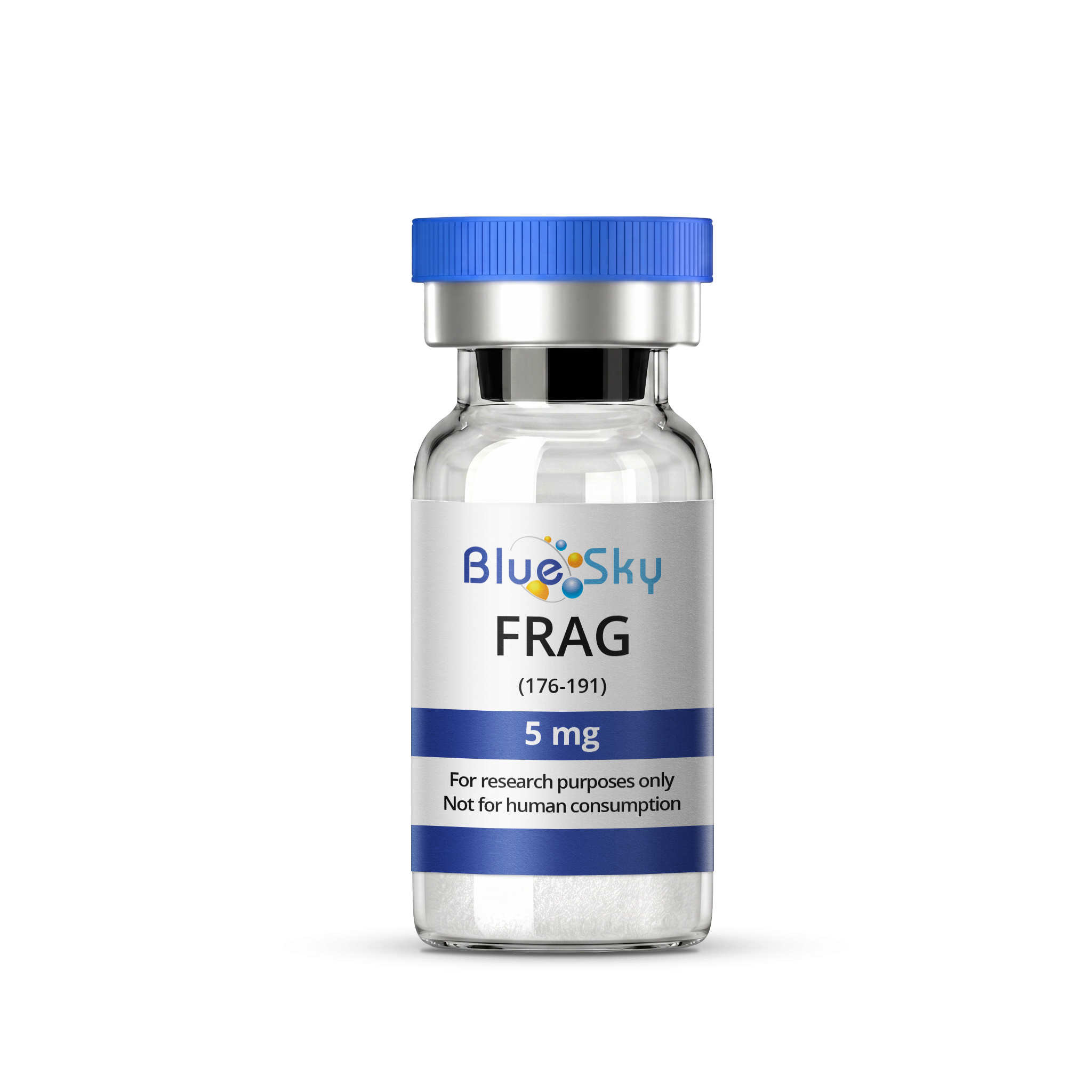
FRAGMENT 176-191 5mg

- Free Priority Shipping
- Orders over $75



FRAGMENT 176-191 5mg :
| Unit Size | 5 mg/vial |
| Unit Quantity | 1 vial |
| Purity (Mass Spectrometry and UV) | 99.56% |
| Sequence | H-Tyr-Leu-Arg-Ile-Val-Gln-Cys-Arg-Ser-Val-Glu-Gly-Ser-Cys-Gly-Phe-OH |
| Molecular Formula | C78H123N23O23S2 |
| Appearance | Lyophilized White Powder |
| Source | Chemical Synthesis |
| Storage |
Lyophilized FRAGMENT 176-191 is stable at room Temperature for 90 days, however it is best to storer in a freeze below - 8c for any extended period of time. |
| Terms | The products we offer are intended for laboratory research use only. Please familiarize yourself with our terms of service prior to ordering. |
FRAGMENT 176-191 5mg
View Research Overview & References
Fragment 176-191 is a synthetic peptide analog of human growth hormone (hGH) with a molecular weight of approximately 1815 g/mol. This peptide consists of 16 amino acids from the C-terminus of hGH, spanning positions 176 to 191, and includes a substitution of tyrosine to phenylalanine at position 191.1
In Vitro Genetic Toxicology Screening
In vitro assays, including the Ames bacterial reverse mutation test and a chromosomal aberration assay in cultured mammalian cells, examined this hGH fragment for genotoxic and cytotoxic potential, alongside general in vitro cytotoxicity screening.2
Peptide Structure and the Cys7–Cys14 Disulfide Bridge
A defining structural feature of Fragment 176-191 is the intramolecular disulfide bond formed between its two cysteine residues, which constrains the peptide into a looped conformation not present in a fully linear hGH-derived fragment.
Researchers studying structure-activity relationships in this peptide class have noted that this cyclization is associated with greater resistance to enzymatic degradation in laboratory assay systems compared to open-chain analogs of the same sequence.
This structural detail is a frequent point of reference when comparing synthesis routes across suppliers, since correct disulfide formation—rather than a free-thiol, reduced state—is considered essential for reproducing the peptide's studied receptor-interaction profile in vitro.
Analytical Purity and Disulfide Bond Verification
Beyond standard sequence confirmation by mass spectrometry, laboratory-grade Fragment 176-191 requires verification that the Cys7–Cys14 disulfide bond has formed correctly rather than the peptide remaining in its reduced, linear state, since both forms share the same amino acid composition but differ in mass and chromatographic behavior.
HPLC combined with mass spectrometry is used to distinguish the oxidized (cyclic) form from residual linear peptide, and researchers designing dose-response experiments are encouraged to review lot-specific analytical data confirming the oxidized state alongside the standard purity percentage.
Storage and Handling in the Laboratory Setting
Peptides containing disulfide bonds are susceptible to reduction under certain storage conditions, particularly in the presence of reducing agents or extended exposure to light and elevated temperature.
Laboratories typically store lyophilized Fragment 176-191 under sub-zero freezer conditions, which helps preserve the oxidized disulfide state relevant to the receptor-binding behavior under investigation.
Comparative Research Context Among hGH-Derived Fragments
Fragment 176-191 is one of several hGH-derived research peptides studied for isolating specific regions of the full-length hormone's activity, distinct from growth hormone secretagogues such as GHRP-class peptides that act upstream at the pituitary to stimulate endogenous hGH release.
Researchers comparing these peptide classes often cite Fragment 176-191's restriction to the hormone's C-terminal domain as a way to isolate this region's signaling from the growth-promoting and IGF-1-mediated effects associated with other domains of the full-length hormone.
Product Information
Fragment 176-191 is supplied as a lyophilized white powder at a concentration of 5 mg/vial.
Important Notice
This product is intended for laboratory research use (in vitro) only. It is not approved for human use under any circumstances, and has not been evaluated for safety or efficacy in humans.
References
1. Harvey S, Martinez-Moreno CG. Growth Hormone: Therapeutic Possibilities—An Overview. Int J Mol Sci. 2018;19(7):2015.
2. Moré MI, Kenley D. Safety and metabolism of AOD9604, a novel nutraceutical ingredient for improved metabolic health. J Endocrinol Metab. 2014;4(3):64-77.


 Login
Login