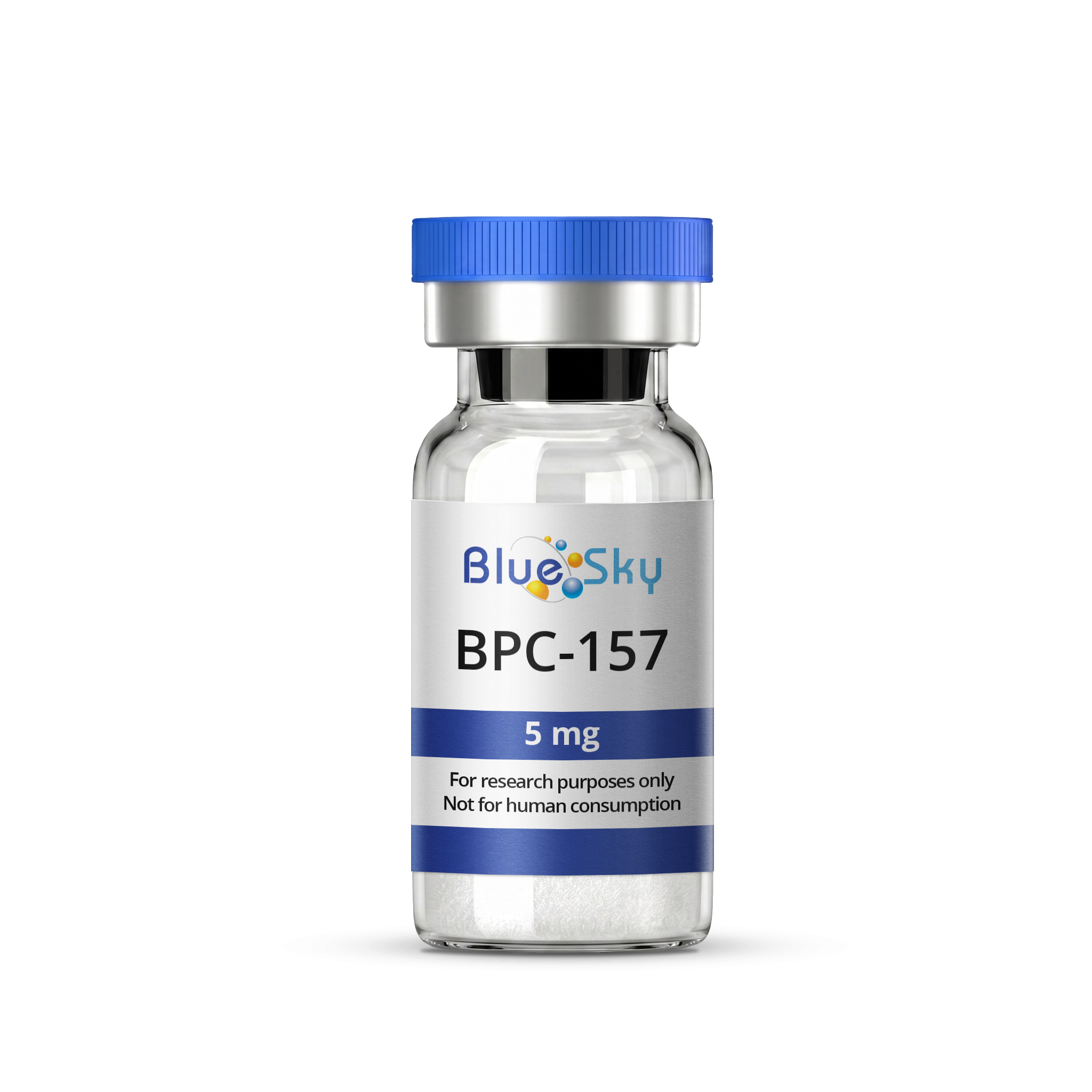
BPC 157 5mg

- Free Priority Shipping
- Orders over $75



Buy 1 Get 1 Free BPC 157 5mg :
| Unit Size | 5 mg/vial |
| Unit Quantity | 1 vial |
| Purity (Mass Spectrometry and UV) | 99.79% |
| Sequence | H-Gly-Glu-Pro-Pro-Pro-Gly-Lys-Pro-Ala-Asp-Asp-Ala-Gly-Leu-Val-OH |
| Molecular Formula | C62H98N16O22 |
| Appearance | Lyophilized White Powder |
| Source | Chemical Synthesis |
| Storage | Lyophilized BPC 157 is stable at room Temperature for 90 days, however it is best to store in a freezer below - 8c for any extended period of time. |
| Terms | The products we offer are intended for laboratory research use only. Please familiarize yourself with our terms of service prior to ordering. |
BPC 157 5mg
View Research Overview
BPC-157 (Body Protection Compound-157) is a synthetic pentadecapeptide (15 amino acids) originally derived from a protein sequence found in human gastric juice.
It is studied in vitro for its interaction with cell signaling pathways relevant to tissue-level cell behavior, including cell migration and proliferation-related signaling.
Peptide Structure and Stability Considerations
BPC-157 is notable among research pentadecapeptides for its unusually high proline content, with roughly a quarter of its fifteen residues being proline.
In peptide chemistry, a proline-dense backbone is understood to impose conformational rigidity, since proline's cyclic side chain restricts the range of rotation available at the peptide bond.
Researchers studying this compound have pointed to this structural feature as a plausible explanation for the peptide's reported resistance to enzymatic degradation, a property that distinguishes it from many other laboratory peptides that break down more readily under similar conditions.
Receptor-Independent Mechanism Considerations
Unlike many bioactive peptides that act through a single, well-defined receptor, BPC-157 has not been linked to one confirmed primary receptor in the research literature, a distinguishing feature researchers frequently note when studying its cell signaling activity.
This has led to research interest in receptor-independent mechanisms, including direct effects on intracellular signaling proteins and cytoskeletal components, as a research framework distinct from classical receptor-ligand pharmacology used for many other short bioactive peptides.
Analytical Purity Verification
As with other synthetic research peptides, BPC-157 batches are commonly verified using a combination of high-performance liquid chromatography (HPLC) and mass spectrometry to confirm both sequence identity and the absence of synthesis byproducts such as truncated or incompletely deprotected fragments.
Purity data reported above 99% by these combined analytical methods is generally treated in laboratory settings as a baseline for experiments where dose-response consistency matters, since even small proportions of impurity peptides can confound cell-migration or signaling assay readouts.
Storage and Handling in the Laboratory Setting
Lyophilized peptide is inherently more resistant to degradation than peptide in solution, which is why laboratories typically retain material in lyophilized form under sub-zero freezer storage until shortly before an experimental session.
Once in solution, peptide bonds become more susceptible to hydrolysis and oxidative breakdown, so laboratory protocols generally recommend avoiding prolonged exposure to ambient temperature or light for any material not in its stable, lyophilized state.
BPC-157 in Comparative Peptide Research
BPC-157 is frequently referenced in the peptide research literature as a point of comparison when investigators evaluate other gut-derived or tissue-signaling peptides, given its distinct proline-rich structural profile relative to more conventional linear peptide sequences.
Researchers designing in vitro protocols involving fibroblast or epithelial cell signaling often cite BPC-157 alongside other regenerative-signaling peptides under study, using its documented stability data as a benchmark for experimental design.
Important Notice
BPC-157 is provided exclusively for laboratory research purposes (in vitro). This peptide is not intended for human consumption or use, and any application outside of controlled laboratory research is prohibited. These findings do not establish safety, efficacy, or suitability for any human application, and have not been evaluated by the FDA or any regulatory agency.
Product Information
BPC-157 is supplied as a lyophilized powder for laboratory research use only.
 Buy Bulk HEXARELIN 2mg$47.95


 Login
Login