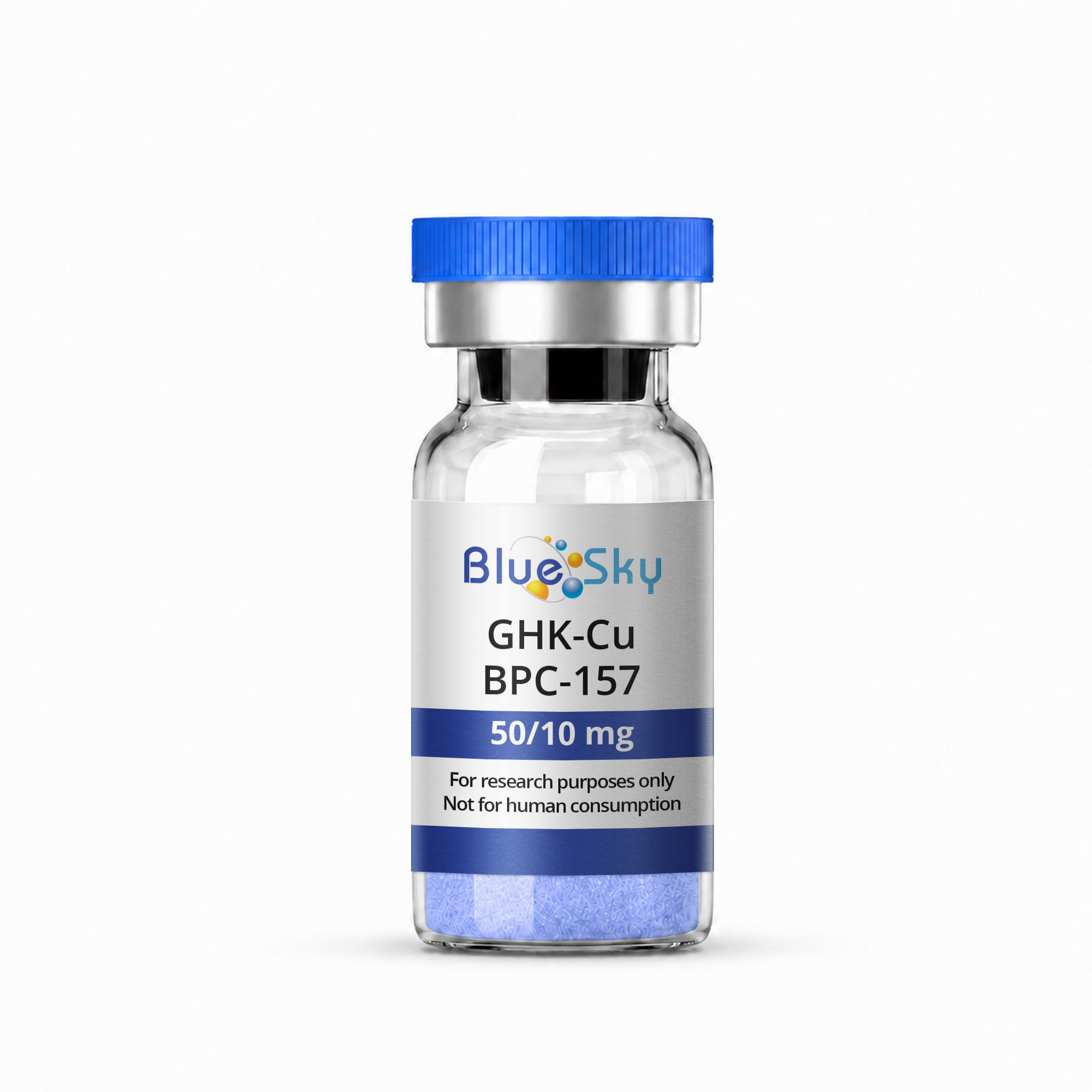
Blend GHK-Cu 50mg with BPC-157 10mg

- Free Priority Shipping
- Orders over $75


Buy 2 Get 1 Free Blend GHK-Cu 50mg with BPC-157 10mg :
| Unit Size | 60 mg/vial |
| Unit Quantity | 1 vial |
| Purity (Mass Spectrometry and UV) | 99.98% Nominal Target: 50 mg GHK-Cu + 10 mg BPC-157 |
| Sequence (GHK-Cu) | Gly-His-Lys.Cu.xHAc |
| Sequence ( BPC-157) | H-Gly-Glu-Pro-Pro-Pro-Gly-Lys-Pro-Ala-Asp-Asp-Ala-Gly-Leu-Val-OH |
| Molecular Formula (GHK-Cu) |
C14H23CuN6O4 |
| Molecular Formula (BPC-157) | C62H98N16O22 |
| Appearance | Lyophilized Powder |
| Source | Chemical Synthesis |
| Storage | Lyophilized Blend GHK-Cu 50mg with BPC-157 10mg is stable at roomTemperature for 90 days, however it is best to store in a freezer below - 8c for any extended period of time. |
| Terms | The products we offer are intended for laboratory research use only. Please familiarize yourself with our terms of service prior to ordering. |
Blend GHK-Cu 50mg with BPC-157 10mg
View Research Overview & References
This blend combines two research-grade synthetic peptides, GHK-Cu and BPC-157, supplied together for in vitro laboratory research into cellular signaling and matrix-related mechanisms.
GHK-Cu Concentration-Dependent Collagen Research
GHK-Cu's collagen-stimulating activity in cultured fibroblasts has been characterized across a range of peptide concentrations, with the effect detectable at concentrations as low as 10-12 M and reaching a maximum increase at 10-9 M in this cell-based system.1
This wide effective concentration range is a frequently cited feature in laboratory literature discussing GHK-Cu's potency relative to other matrix-modulating research peptides.
BPC-157 Receptor-Independent Mechanism Considerations
Unlike many bioactive peptides that act through a single, well-defined receptor, BPC-157 has not been linked to one confirmed primary receptor in the research literature.
This has led to research interest in receptor-independent mechanisms, including direct effects on intracellular signaling proteins and cytoskeletal components, as a framework distinct from classical receptor-ligand pharmacology used for many other short bioactive peptides in cell-based assay design.
Combined Research Applications
This two-peptide blend is studied for research into matrix-related and cell signaling mechanisms within a single controlled research platform.
Combined use of these peptides remains an area of exploratory laboratory research, and available data on interaction effects between the two components is preliminary and not considered conclusive.
Analytical Verification for Blended Products
For a two-component blend combining a three-residue metal complex with a considerably larger fifteen-residue peptide, analytical verification is understood to require confirmation of both components' individual identity and purity, along with the ratio between them.
Researchers reviewing documentation for this blend are encouraged to look for HPLC or mass spectrometry data resolving GHK-Cu and BPC-157 as separate peaks.
Storage and Handling in the Laboratory Setting
GHK-Cu's copper coordination is understood to confer some resistance to proteolytic degradation, while BPC-157's proline-dense backbone offers a similar, independently derived stability advantage.
Despite these structural differences, the lyophilized blend is stored under sub-zero freezer conditions to preserve both components' integrity prior to use.
Important Notice
These peptides are synthesized, blended, and supplied strictly for in vitro laboratory research purposes only. They are not intended for human consumption, diagnostic use, or therapeutic application, and have not been evaluated for safety or efficacy in humans.
References
1. Maquart FX, Pickart L, Laurent M, Gillery P, Monboisse JC, Borel JP. Stimulation of collagen synthesis in fibroblast cultures by the tripeptide-copper complex GHK-Cu. FEBS Lett. 1988;238(2):343-346.


 Login
Login