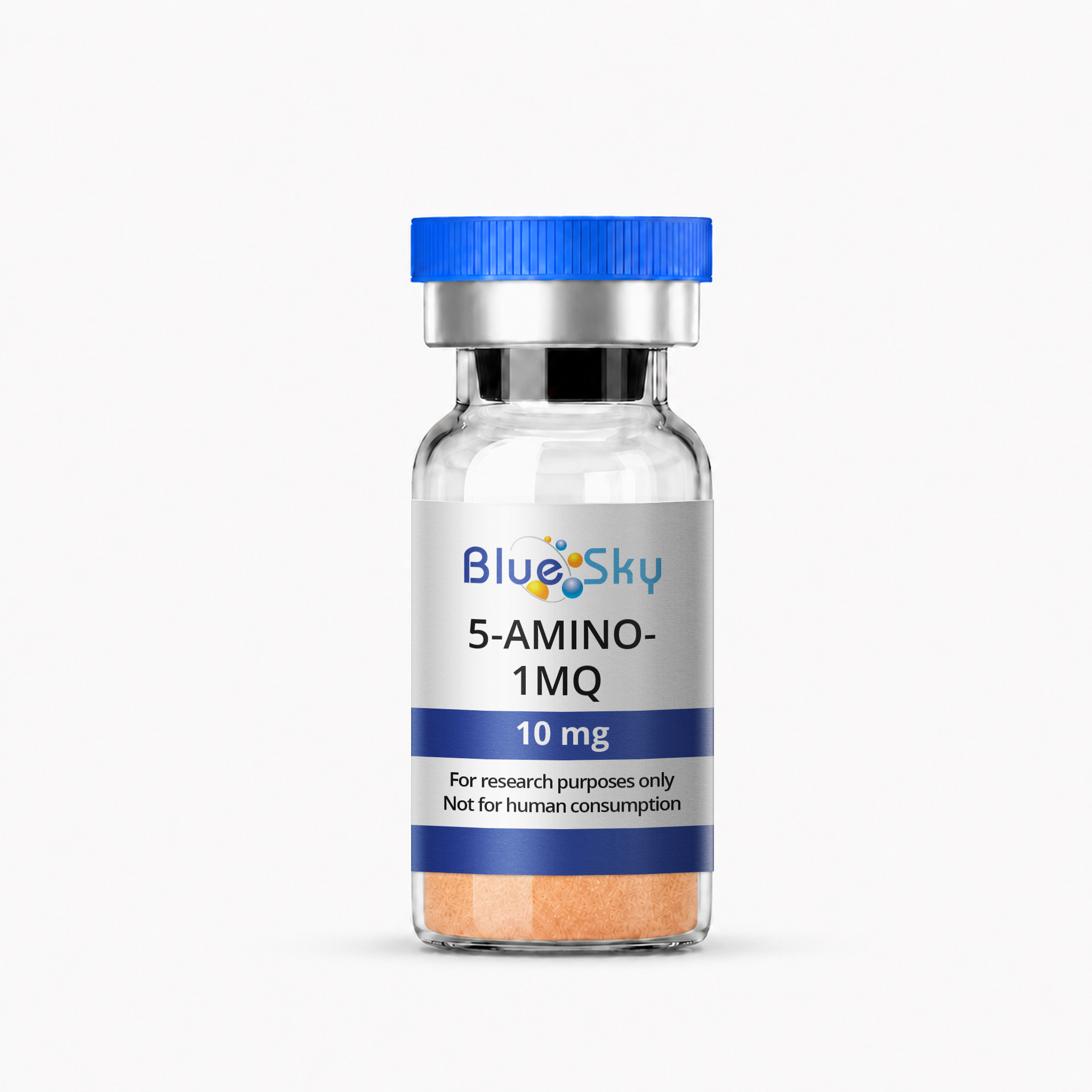
5-AMINO-1MQ 10mg

- Free Priority Shipping
- Orders over $75



5-AMINO-1MQ 10MG :
| Unit Size | 10 mg/vial |
| Unit Quantity | 1 vial |
| Purity (Mass Spectrometry & UV) | 98.48% |
| Molecular Formula | C10H11N2+ |
| Appearance | White to off-white powder |
| Source | Chemical Synthesis |
| Storage | 5-AMINO-1MQ is stable at room temperature for up to 90 days; however, for long-term storage, it is recommended to store in a freezer below -8°C. |
| Terms | The products we offer are intended for laboratory research use only. Please familiarize yourself with our terms of service prior to ordering. |
5-AMINO-1MQ 10mg
View Research Overview & References
5-Amino-1MQ is a small-molecule quinolinium compound studied in laboratory research as a selective inhibitor of nicotinamide N-methyltransferase (NNMT), an intracellular enzyme involved in methylation metabolism. This product is studied in vitro (cell-based laboratory research) and is not intended for human use or consumption.
Why NNMT Is a Cellular Metabolism Research Target
NNMT transfers a methyl group from S-adenosyl-L-methionine (SAM) onto nicotinamide, producing 1-methylnicotinamide (1-MNA) and S-adenosylhomocysteine as byproducts. Because nicotinamide is also a direct precursor in the NAD+ salvage pathway, researchers have proposed that NNMT activity competes with NAD+ regeneration for the same starting material.
This competing-pathway relationship is the basis for using selective NNMT inhibitors like 5-Amino-1MQ as tools for studying methylation capacity and NAD+-related signaling in isolation from other cellular processes in cell culture models.
Enzyme Inhibition Research
Laboratory research has characterized 5-Amino-1MQ's selectivity for NNMT relative to other methyltransferase enzymes, along with its membrane permeability in cultured cell models. NAD+ and 1-MNA levels are commonly used as markers of on-target enzyme engagement in this type of cell-based research.
Muscle Stem Cell Research
Laboratory research has examined NNMT inhibition in relation to muscle stem cell proliferation and differentiation markers using in vitro C2C12 myoblast cell culture systems, a standard cell-based model for studying muscle cell differentiation.1 These are laboratory observations in a cell culture model and do not establish safety, efficacy, or suitability for any human application.
Chemical Structure and Inhibition Mechanism
5-Amino-1MQ is built on a 1-methylquinolinium core, a quaternized aromatic nitrogen structure identified as a substrate-site-targeting scaffold for NNMT inhibition. This means the molecule competes directly with the enzyme's natural substrate, nicotinamide, at the same binding site rather than binding elsewhere on the enzyme.
Two structural features of this scaffold are frequently discussed in the laboratory literature:
- The 5-amino substituent added to the quinolinium core, studied for improving selectivity for NNMT over structurally related methyltransferases
- The compound's passive membrane permeability, which distinguishes it from earlier-generation NNMT inhibitors that lacked one or both properties
Analytical Purity Verification
Because 5-Amino-1MQ is typically supplied as a quinolinium salt (commonly the iodide salt) rather than as the free cation, researchers reviewing a certificate of analysis are encouraged to check for a few specific details:
- Which salt form and counter-ion is present, since this affects the compound's effective molecular weight and the mass of active compound per milligram of powder
- Confirmation via combined HPLC and mass spectrometry, consistent with standard practice for small-molecule research reagents of this type
- Consistency of purity data across batches, since quinolinium salts can be prone to lot-to-lot variability during synthesis
Storage and Handling in the Laboratory Setting
Quinolinium salts such as 5-Amino-1MQ are generally hygroscopic and can be sensitive to prolonged light exposure, making sealed storage under sub-zero freezer conditions the standard laboratory practice for the powder form.
Comparative Research Context Among NNMT Inhibitors
5-Amino-1MQ is frequently referenced in laboratory literature alongside other classes of NNMT inhibitors developed since its initial characterization:
- Tricyclic small-molecule inhibitors, studied for a distinct binding mode within the NNMT active site
- Nicotinamide analog inhibitors, designed as closer structural mimics of the enzyme's natural substrate
Researchers comparing these inhibitor classes have focused on differences in binding mode, selectivity profile, and enzyme inhibition potency, using 5-Amino-1MQ's substrate-site-targeting mechanism as a reference point when evaluating newer NNMT-directed compounds in laboratory assay systems.
Important Notice
5-Amino-1MQ is intended for laboratory research use only (in vitro) and is not for human use or consumption. No human clinical studies of this compound have been published in the scientific literature.
Any application outside of controlled in vitro laboratory research is prohibited, and these findings do not establish safety, efficacy, or suitability for any human application. This product has not been evaluated by the FDA or any regulatory agency.
Product Information
5-Amino-1MQ is supplied as a research reagent for laboratory use only, in accordance with standard laboratory safety and handling protocols.
References
1. Neelakantan H, Brightwell CR, Graber TG, et al. Small molecule nicotinamide N-methyltransferase inhibitor activates senescent muscle stem cells and improves regenerative capacity of aged skeletal muscle. Biochem Pharmacol. 2019;163:481-492.


 Login
Login